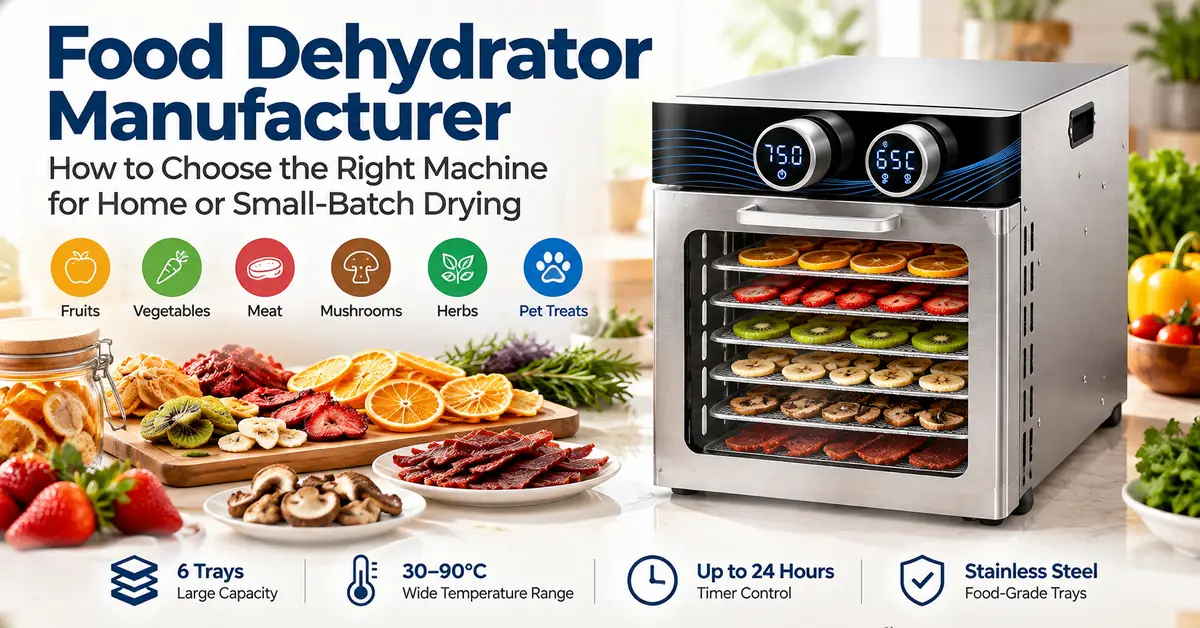
Introduction: Why Stainless Steel Quality Matters When Buying a Food Dehydrator
Imagine preparing a large batch of apple slices, strawberries, mushrooms, and fresh herbs for your family. You want an appliance that is convenient to use, easy to clean, and capable of drying different ingredients without constantly rearranging your kitchen.
After comparing several machines, you notice that many are advertised as stainless steel food dehydrators.
But what does that description actually mean?
Some machines use stainless steel trays with a different metal grade for the outer cabinet. Others have different tray sizes, temperature controls, and internal arrangements, even when they look almost identical.
A dehydrator with 18 trays may provide only slightly more nominal drying area than a 12-tray model with larger shelves.
These differences matter because the right food dehydrator should match your food preparation habits, cleaning expectations, available kitchen space, and budget.
Choosing a reliable stainless steel food dehydrator manufacturer means looking beyond appearance and checking the materials, specifications, construction, and support behind the equipment.
This guide explains what to look for and compares actual models from SZK Kitchen's food dehydrator collection.
Quick Answer: What Should You Look for in a Stainless Steel Food Dehydrator Manufacturer?
Choose a stainless steel food dehydrator manufacturer that clearly identifies food-contact materials, cabinet construction, tray dimensions, temperature range, and cleaning requirements. Look for corrosion-resistant trays, adjustable controls, suitable airflow, and a size that matches your drying habits. Compare actual loading area—not tray count alone—and confirm electrical compatibility, maintenance instructions, and product support before buying.
Why Choose a Stainless Steel Food Dehydrator?
A food dehydrator removes moisture from ingredients by combining controlled heat with airflow.
This makes it useful for preparing dried foods at home, experimenting with recipes, and processing certain ingredients in small batches.
Stainless steel is a common material in food-processing equipment because suitable grades can provide durable, corrosion-resistant surfaces that are practical to maintain.
However, the benefits depend on the material grade, surface finish, manufacturing quality, and intended use.
1. Practical for Everyday Food Preservation
A food dehydrator can help prepare:
-
Dried apple, orange, banana, and strawberry slices
-
Dried mushrooms for cooking
-
Herbs and seasonings
-
Vegetable ingredients for soups
-
Homemade fruit snacks
-
Selected ingredients for camping meals
For people who regularly buy fresh produce, dehydration offers another way to prepare food for later use.
Proper drying and storage are essential, however. Simply removing some moisture does not guarantee that every food will be safe for long-term storage.
2. Suitable for Different Household Sizes
A small household may only need enough drying space for a few trays of fruit.
A family preparing dried snacks every week may appreciate a larger configuration.
For example, a six-tray model may be practical for occasional use, while 12- or 18-tray machines can accommodate more separate layers.
The most suitable capacity depends on the dimensions of each tray and how much food you normally prepare.
3. Useful for Small-Batch Food Preparation
Stainless steel dehydrators may also appeal to:
-
Home-based food entrepreneurs
-
Specialty dried fruit producers
-
Small food development kitchens
-
Culinary enthusiasts
-
Kitchen equipment retailers
Small businesses should evaluate electrical requirements, actual drying capacity, sanitation procedures, and intended operating frequency.
A household countertop dehydrator should not automatically be considered suitable for continuous industrial production.
4. Who May Not Need a Large Stainless Steel Dehydrator?
A larger cabinet may not be worthwhile if you have limited counter space, rarely dry food, or prepare only very small batches.
Similarly, a conventional hot-air dehydrator is not a substitute for a vacuum freeze dryer.
Understanding your actual requirements prevents unnecessary spending on features or capacity you may never use.
What to Check When Choosing a Stainless Steel Food Dehydrator
1. Understand 201 vs. 304 Stainless Steel
One of the most important questions to ask a stainless steel food dehydrator manufacturer is:
Which parts are made from 304 stainless steel, and which parts use other materials?
Stainless steel is not a single material. Different grades have different alloy compositions and corrosion-resistance characteristics.
Two grades commonly encountered in kitchen equipment are 201 and 304 stainless steel.
| Feature | 201 Stainless Steel | 304 Stainless Steel |
|---|---|---|
| General composition | Chromium-nickel-manganese stainless steel | Chromium-nickel stainless steel |
| Corrosion resistance | Generally lower in demanding conditions | Generally better for many kitchen environments |
| Typical equipment use | Cabinets and structural components | Trays and many food-contact surfaces |
| Relative material cost | Often lower | Often higher |
| Purchasing priority | Check finish, environment, and construction | Check grade, finish, and suitability for food contact |
Both grades can be useful in appropriate equipment applications.
A 201 stainless steel outer cabinet is not automatically a product defect.
The more important distinction is whether the components that contact food are made from suitable materials and designed for hygienic use.
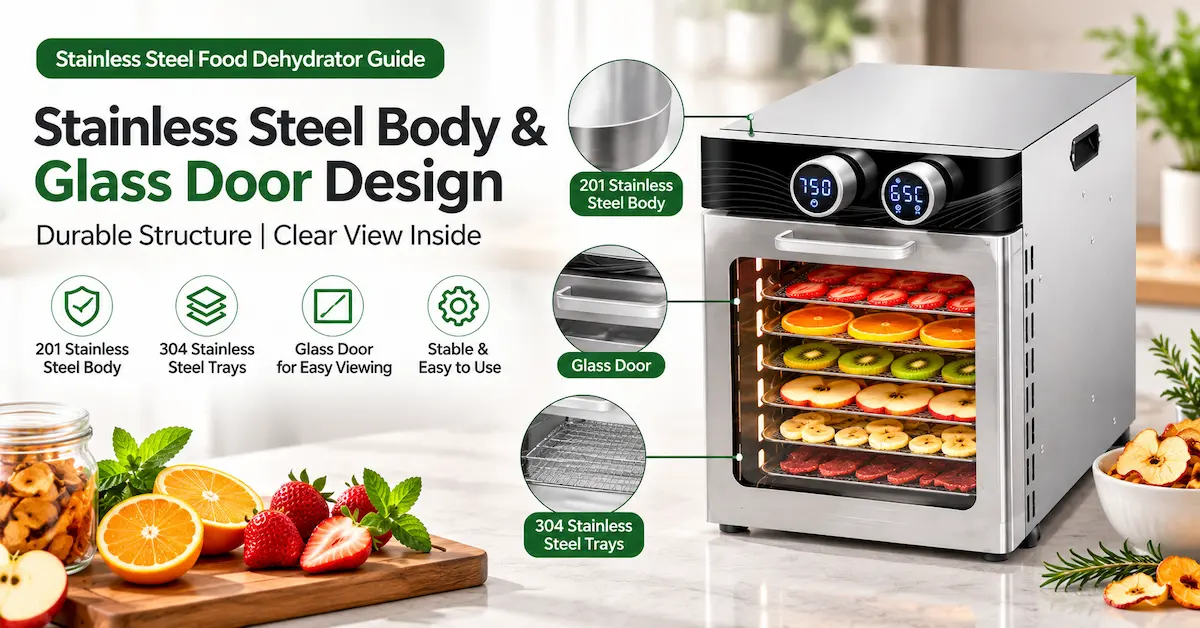
For example, several SZK Kitchen dehydrator models list:
-
201 stainless steel: Main cabinet body
-
304 stainless steel: Food-drying trays
-
Glass: Front viewing panel
This construction separates the external structure from the food-contact tray surfaces.
The University of Florida IFAS Extension identifies stainless steel as a preferred material for many food equipment surfaces while emphasizing the importance of cleanability, surface condition, and corrosion resistance.
Material grade alone, however, does not establish that an entire appliance is certified or compliant with every food-contact requirement.
Buying tip: Ask for the exact material specifications of the trays, supports, and other relevant food-contact surfaces. For commercial or imported products, request applicable documentation for the destination market.
2. Compare Tray Size Instead of Counting Trays
The number of trays is an important specification, but it does not tell you how much usable drying space a machine provides.
Consider four SZK Kitchen food dehydrator configurations.
| Model | Number of Trays | Tray Dimensions | Nominal Total Tray Area |
|---|---|---|---|
| 6-Tray Electronic Dial | 6 | 29 × 29 cm | 0.505 m² |
| 12-Tray Compact | 12 | 28.5 × 20 cm | 0.684 m² |
| 12-Tray Angled | 12 | 29 × 29 cm | 1.009 m² |
| 18-Tray Compact | 18 | 28.5 × 20 cm | 1.026 m² |
Nominal tray areas are calculated from the published tray dimensions multiplied by tray count. These figures do not represent verified usable loading capacity or measured drying output.
Notice the difference between the 12-tray angled model and the 18-tray compact model.
The 12-tray model uses larger individual trays and provides nearly the same nominal total tray area as the 18-tray configuration.
This means a higher tray count does not always provide proportionally greater loading space.
When comparing machines, consider:
-
Individual tray width and depth
-
Tray spacing
-
Available cabinet height
-
Air circulation requirements
-
Ease of loading and unloading
-
Cleaning time
Recommendation: Choose based on the size and quantity of ingredients you regularly prepare, not simply the largest advertised tray count.
3. Check Temperature Control and Timer Functions
Different ingredients require different drying conditions.
A machine with adjustable temperature settings gives users more flexibility when preparing fruit, vegetables, herbs, and other suitable foods.
Several SZK Kitchen dehydrators list:
-
Rated power: 800W
-
Adjustable temperature: 30–90°C
-
Timer settings extending up to 24 hours
-
Electronic dial or knob controls
-
Digital displays on selected models
These specifications support different food-drying applications.
However, a broad temperature range does not automatically guarantee uniform heating across every tray.
Airflow design, ingredient thickness, loading patterns, and cabinet construction also influence drying results.
The National Center for Home Food Preservation identifies a fan, thermostat, accessible trays, and appropriate drying space as important considerations when choosing a dehydrator.
Before buying, review the user manual and determine whether the control system suits your experience level.
4. Consider Cleaning and Maintenance
A stainless steel dehydrator should be easy to maintain, especially when used frequently.
Look for:
-
Removable drying trays
-
Accessible interior surfaces
-
Smooth tray edges
-
A door that opens conveniently
-
Clear cleaning instructions
-
Suitable replacement accessories
Cleaning matters because food residue can accumulate on trays and other surfaces.
After each drying session, allow the machine to cool and clean removable components according to the manufacturer's instructions.
Avoid assuming that stainless steel trays are automatically dishwasher-safe.
Also avoid aggressive abrasive cleaning or prolonged exposure to unsuitable chemicals, which may damage surfaces.
A clean, dry, well-maintained machine is generally easier to keep in satisfactory operating condition.
5. Measure Your Kitchen Space
Before choosing a model, compare appliance dimensions with your available countertop and storage space.
For example:
| Model | Product Dimensions | Main Space Consideration |
|---|---|---|
| 6-Tray Electronic Dial | 31.7 × 43.2 × 33.5 cm | Lower cabinet, wider footprint |
| 12-Tray Compact | 30 × 31 × 41 cm | Narrower countertop footprint |
| 18-Tray Compact | 30 × 31 × 55.5 cm | Requires greater vertical clearance |
A larger number of trays does not always mean the appliance occupies more countertop width.
Check the manufacturer's ventilation requirements and allow enough space for opening the door, removing trays, and safe operation.
6. Consider Price, Electrical Requirements, and Product Support
Purchase price is only one part of the decision.
Compare the machine's features, expected usage, cleaning effort, shipping charges, and maintenance requirements.
For electrical appliances, confirm voltage, frequency, and plug compatibility with your country.
For buyers purchasing from a stainless steel food dehydrator manufacturer, it is also helpful to ask about warranty terms, replacement parts, material documentation, and available product support.
Stainless Steel Food Dehydrator Comparison: Which Model Should You Buy?
The following comparison helps match different configurations to common purchasing needs.
| Model | Main Advantages | Main Trade-Off | Recommended For |
|---|---|---|---|
| 6-Tray Electronic Dial | Fewer trays, 304 stainless steel trays, adjustable controls | Smaller total tray area | Occasional home drying |
| 12-Tray Compact | Compact footprint, 12 levels, digital display | Smaller individual trays | Families and regular users |
| 12-Tray Angled | Larger trays, recipe preset functions | Wider cabinet | Frequent drying with larger trays |
| 18-Tray Compact | More individual loading levels, higher listed volume | Taller cabinet, more trays to clean | Frequent multi-tray drying |
Which Is Better: 12 Trays or 18 Trays?
If your priority is a large individual tray, the 12-tray angled model may be attractive.
If you prefer more separate layers in a relatively narrow cabinet, the 18-tray compact model may be more suitable.
Neither configuration is automatically better.
The choice depends on food quantity, slice size, available space, cleaning preferences, and actual drying performance.
Is a Stainless Steel Dehydrator Worth the Extra Cost?
It may be worthwhile for buyers who value durable removable trays and a metal cabinet.
However, a higher material cost does not automatically guarantee superior drying performance.
A well-designed machine with suitable temperature control, airflow, and cleanable surfaces may offer better practical value than a more expensive appliance chosen only for its stainless steel appearance.
Common Food Dehydrator Buying Mistakes and Practical Tips
Mistake 1: Assuming the Entire Machine Is 304 Stainless Steel
A stainless steel dehydrator may use different grades for the body and trays.
Check the exact components instead of relying on broad product descriptions.
Mistake 2: Overloading Drying Trays
Arrange ingredients in a single layer where possible, leaving suitable space for airflow.
Overlapping food or tightly packed trays can lead to inconsistent drying.
Mistake 3: Using the Same Temperature for Every Ingredient
Fruits, vegetables, herbs, and meats have different preparation and food safety requirements.
Follow validated instructions for each ingredient and the operating directions supplied with the appliance.
For meat jerky and animal-based treats, additional heat-treatment and food safety procedures may be required. A dehydrator's maximum air temperature alone is not proof of safe processing.
Mistake 4: Ignoring Food Thickness
Cut ingredients into reasonably consistent pieces.
Thicker pieces generally require more drying time than thinner slices under comparable conditions.
Mistake 5: Storing Food Before It Has Cooled
Allow dried ingredients to cool before packaging.
Store properly dried foods in suitable moisture-resistant containers and follow food-specific storage guidance.
The National Center for Home Food Preservation provides tested recommendations for preparing and storing dried foods.
Mistake 6: Buying a Large Machine Without Considering Cleaning
More trays mean more separate components to remove, clean, dry, and store.
A smaller model may be easier to use regularly if your typical batches are modest.
Recommended Stainless Steel Food Dehydrators from SZK Kitchen
SZK Kitchen, associated with Tiansui Electric and its manufacturing operations in Foshan, China, offers several dehydrator configurations with stainless steel trays.
The following products are worth comparing based on their published specifications.
1. 6-Tray Food Dehydrator with Electronic Dial Control
The 6-Tray Food Dehydrator with Electronic Dial Control is designed for users seeking a smaller number of trays.
Key specifications:
-
6 removable trays
-
29 × 29 cm tray dimensions
-
304 stainless steel trays
-
201 stainless steel body
-
800W rated power
-
30–90°C temperature adjustment
-
Timer up to 24 hours
Best for: Individuals, couples, and households preparing smaller quantities of dried foods.
View 6-Tray Food Dehydrator Details
2. 12-Tray Compact Food Dehydrator
The 12-Tray Compact Food Dehydrator with Digital Display and Knob Control provides additional loading levels in a comparatively narrow cabinet.
Key specifications:
-
12 stainless steel trays
-
28.5 × 20 cm tray dimensions
-
304 stainless steel trays
-
18.5L listed internal capacity
-
800W rated power
-
Adjustable temperature control
-
Digital display and knob control
Best for: Families and regular home users who want additional tray levels without a wide cabinet.
Explore the 12-Tray Compact Dehydrator
3. 18-Tray Compact Food Dehydrator
The 18-Tray Compact Food Dehydrator offers more separate drying levels.
Key specifications:
-
18 stainless steel trays
-
28.5 × 20 cm tray dimensions
-
304 stainless steel trays
-
27L listed internal capacity
-
800W rated power
-
30–90°C temperature range
-
Product height: 55.5 cm
Best for: Frequent food preparation and users who prefer distributing ingredients across more individual trays.
View the 18-Tray Food Dehydrator
4. 12-Tray Angled Food Dehydrator with Recipe Presets
The 12-Tray Angled Food Dehydrator offers larger individual trays and recipe preset functions.
Its 29 × 29 cm trays provide approximately 1.009 m² of nominal total tray area.
Best for: Buyers who prefer larger loading surfaces and additional control functions.
Explore the 12-Tray Angled Dehydrator
Why Consider SZK Kitchen?
For consumers and equipment buyers evaluating a stainless steel food dehydrator manufacturer, access to clear product specifications and different model configurations is important.
SZK Kitchen's food dehydrator product range includes several options with different tray counts, controls, and dimensions.
The company also describes OEM/ODM support for business customers interested in branding, packaging, and selected product customization.
Actual customization scope, product documentation, sample availability, and destination-market requirements should be confirmed for the selected model.
Ready to choose a food dehydrator?
Explore All Stainless Steel Food Dehydrators or Contact SZK Kitchen for product specifications, ordering information, or OEM/ODM inquiries.
Frequently Asked Questions
1. Is 304 stainless steel better than 201 stainless steel for food dehydrator trays?
304 stainless steel generally provides better corrosion resistance in many kitchen environments, making it a commonly used material for food-contact equipment.
201 stainless steel can still be suitable for certain structural or external components.
Always evaluate the specific application, surface finish, cleaning requirements, and applicable material documentation.
2. Does a stainless steel food dehydrator dry food faster?
Not necessarily.
Drying performance depends on temperature, airflow, ingredient thickness, moisture content, and loading conditions.
Stainless steel construction alone does not establish faster drying or better temperature uniformity.
3. How many trays should a family choose?
For occasional drying, a six-tray configuration may be sufficient.
Families who regularly prepare dried foods may benefit from 12 or more trays.
Compare actual tray dimensions, available space, and how much food you typically prepare.
4. Are stainless steel dehydrator trays dishwasher-safe?
Not all stainless steel trays are automatically dishwasher-safe.
Follow the instructions for the specific appliance.
When dishwasher compatibility is not confirmed, use the manufacturer's recommended manual cleaning method.
5. Can I use a stainless steel dehydrator for meat and pet treats?
Some dehydrators can be used as part of properly validated meat-drying processes, but additional preparation and heat-treatment steps may be required.
Follow reliable food safety guidance rather than relying only on the appliance temperature setting.
6. Can I buy directly from a stainless steel food dehydrator manufacturer?
Some manufacturers offer individual product orders as well as wholesale and OEM/ODM purchasing options.
SZK Kitchen lists standard dehydrator models and provides a contact channel for order and customization inquiries.
Check the exact model's availability, minimum order requirements, electrical version, and shipping destination before purchasing.
Conclusion
Choosing a stainless steel food dehydrator requires more than comparing tray numbers and product appearance.
The most important considerations include food-contact materials, tray dimensions, temperature controls, cleaning convenience, kitchen space, and electrical compatibility.
For many buyers, 304 stainless steel trays paired with a suitable cabinet design can provide a practical construction option. However, material grade alone should never replace an evaluation of product quality and usability.
A six-tray dehydrator may suit occasional home use, while 12- and 18-tray configurations provide additional options for households and small-batch users.
The best choice depends on how much food you prepare, how frequently you use the appliance, and how much space you can accommodate.
If you are comparing products from a stainless steel food dehydrator manufacturer, prioritize transparent specifications, appropriate materials, and products that match your actual requirements.
Browse the SZK Kitchen Food Dehydrator Collection to compare available models, or contact SZK Kitchen for product information, purchasing assistance, and OEM/ODM inquiries.