Introduction: Why Choosing the Right Food Dehydrator Matters
Imagine buying fresh strawberries, apples, and herbs for your family, only to find that some of them spoil before you have a chance to use them. Or perhaps you regularly prepare dried fruit snacks and want a more convenient way to process several batches at home.
A food dehydrator can help turn fresh ingredients into convenient dried foods through controlled heat and airflow. However, choosing the wrong machine can create new problems: insufficient tray space, uneven drying, difficult cleaning, or equipment that takes up more room than expected.
The challenge becomes even greater when comparing dozens of products that appear similar.
A machine with 18 trays may not necessarily be much more productive than one with 12 larger trays. Likewise, higher wattage does not automatically mean faster or more efficient drying.
That is why choosing a reliable food dehydrator manufacturer matters. Beyond the product's appearance, buyers should understand its construction, temperature control, usable drying area, cleaning requirements, and electrical compatibility.
In this guide, we examine these factors using actual dehydrator specifications from SZK Kitchen's food dehydrator collection, helping households, hobbyists, small food businesses, and equipment buyers make more informed decisions.
Quick Answer: How Do You Choose a Reliable Food Dehydrator Manufacturer?
A reliable food dehydrator manufacturer should provide clear specifications for tray size, temperature range, timer settings, food-contact materials, electrical requirements, and product support. Choose a 6-tray model for smaller drying batches or compare 12- and 18-tray machines for more frequent use. Always calculate usable tray area, check countertop dimensions, and confirm voltage compatibility rather than selecting a dehydrator by tray count or price alone.
Why Buy a Food Dehydrator? Benefits and Applications
A food dehydrator removes moisture from food using controlled heating and airflow. Proper dehydration, followed by appropriate cooling and storage, can help preserve many ingredients for later use.
Different users benefit from different equipment configurations.
1. Everyday Home Food Preservation
For households that regularly purchase fresh produce, a food dehydrator can be useful for preparing:
-
Dried apple, banana, orange, and strawberry slices
-
Dried mushrooms and vegetables
-
Herbs for cooking and seasoning
-
Homemade fruit snacks and fruit leather, with suitable accessories
-
Ingredients for soups, camping meals, and trail snacks
Drying food at home also allows users to control ingredients and preparation methods.
However, dehydration does not make every food automatically shelf-stable. Safe preparation, proper drying, and moisture-resistant storage are essential.
2. Families Preparing Larger Batches
Families who frequently prepare dried fruit or vegetables may benefit from a multi-tray stainless steel food dehydrator.
Multiple trays allow different ingredients to be arranged separately while increasing the available drying area.
For example, someone drying several kilograms of sliced fruit over multiple sessions may find a 12-tray or 18-tray configuration more convenient than a smaller machine.
The right choice still depends on tray dimensions and how much food can be spread in a single layer.
3. Small Food Businesses and Specialty Producers
Food dehydrators can also support small businesses producing dried fruit, herbs, vegetable ingredients, or specialty snacks.
Common applications include:
-
Small-batch dried fruit preparation
-
Herb and spice ingredient processing
-
Test batches for packaged snack development
-
Product research for private-label dried foods
-
Ingredient preparation for foodservice businesses
Businesses should distinguish between testing capacity and validated commercial production capacity.
A countertop dehydrator may be useful for developing recipes or preparing small batches, but it should not be assumed to replace a higher-capacity industrial drying system.
4. Who Might Not Need a Large Dehydrator?
A large multi-tray unit may not be the best purchase if you:
-
Dry food only a few times per year
-
Have limited storage space
-
Need to process only very small quantities
-
Require freeze-dried rather than hot-air-dried foods
-
Cannot provide suitable ventilation or electrical connections
Choosing the smallest practical machine may provide better everyday value than buying unused capacity.
Key Buying Factors: What Should You Check Before Choosing a Food Dehydrator Manufacturer?
1. Tray Count vs. Actual Drying Area
One of the most common mistakes is comparing dehydrators based only on the number of trays.
A dehydrator with 12 larger trays can offer almost the same nominal loading area as an 18-tray machine with smaller trays.
Consider these actual SZK Kitchen models:
| Model | Tray Dimensions | Tray Count | Approx. Total Tray Area |
|---|---|---|---|
| 6-Tray Electronic Dial | 29 × 29 cm | 6 | 0.505 m² |
| 12-Tray Compact | 28.5 × 20 cm | 12 | 0.684 m² |
| 12-Tray Angled | 29 × 29 cm | 12 | 1.009 m² |
| 18-Tray Compact | 28.5 × 20 cm | 18 | 1.026 m² |
The total tray areas above are calculated from the manufacturer's published tray dimensions multiplied by the number of trays. They are nominal geometric areas, not tested usable capacity or guaranteed food throughput.
What does this mean for buyers?
The 12-tray angled model offers approximately 1.009 m² of nominal tray area, compared with approximately 1.026 m² for the 18-tray compact model.
Despite having six fewer trays, the angled model offers a very similar total geometric loading area.
However, tray shape, spacing, airflow, and the arrangement of food still affect practical drying results.
Buying recommendation: Compare tray dimensions and loading area before assuming a higher tray count provides better value.
2. Kitchen Space and Product Dimensions
A food dehydrator needs enough room for installation, ventilation, opening the door, and removing trays.
The equipment footprint matters just as much as its internal capacity.
For example:
-
The 6-tray electronic dial model measures 31.7 × 43.2 × 33.5 cm.
-
The 12-tray compact model measures 30 × 31 × 41 cm.
-
The 18-tray compact model measures 30 × 31 × 55.5 cm.
Interestingly, the 12-tray compact model has a smaller nominal countertop footprint than the 6-tray electronic dial model, although it is taller.
This illustrates why tray count alone is a poor guide to kitchen fit.
Before ordering, measure the available space and ask about the required ventilation clearance specified for the chosen model.
3. Temperature Range and Timer Control
Different foods require different drying conditions.
A machine with adjustable temperature and timer settings gives users more flexibility when preparing ingredients with different moisture contents.
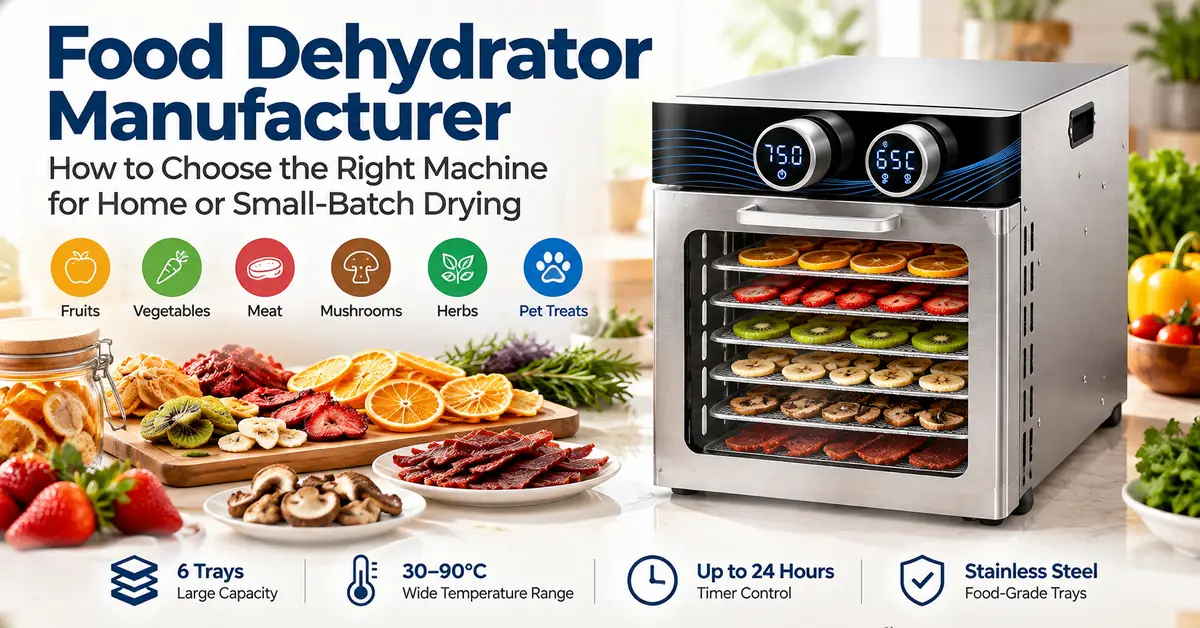
Several SZK Kitchen dehydrators provide:
-
Adjustable temperature settings from 30°C to 90°C
-
Timers of up to 24 hours
-
Electronic dial or knob controls
-
Digital displays on selected models
-
Recipe preset functions on certain configurations
These features can make it easier to select appropriate operating settings.
Nevertheless, a wide temperature range does not guarantee identical drying performance across every tray.
A useful question for any food dehydrator manufacturer is:
How is temperature consistency checked under a representative food load?
Buyers can also ask whether operating instructions provide recommended settings and drying guidelines for common ingredients.
4. Stainless Steel Materials and Cleaning
Material selection affects durability, cleaning, and the long-term ownership experience.
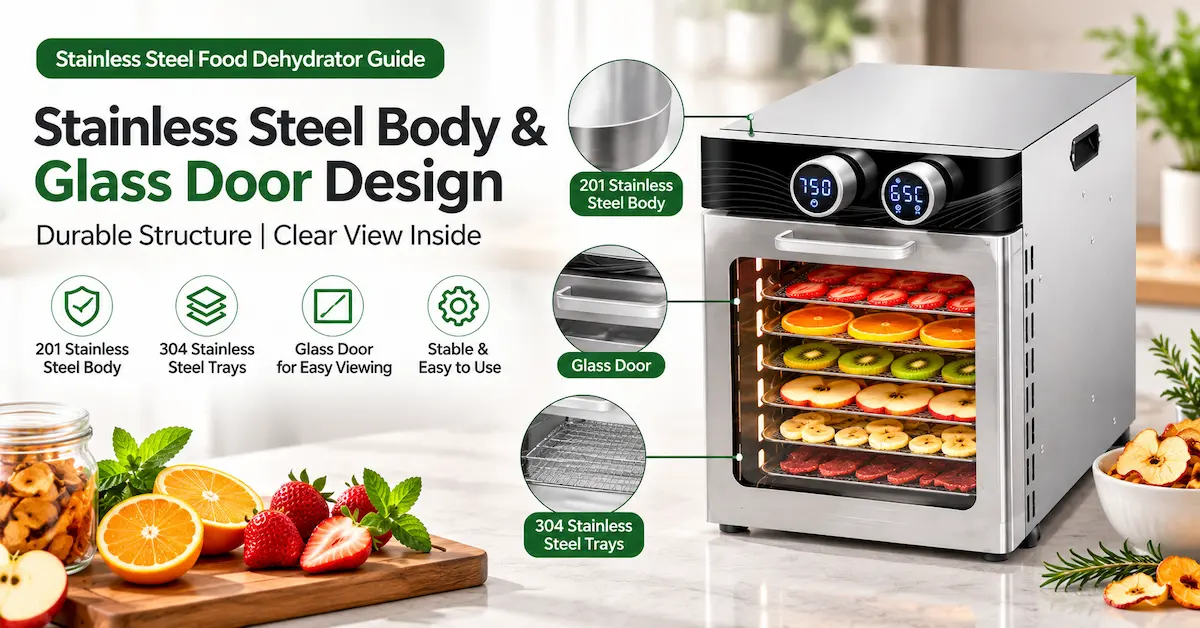
Several SZK Kitchen dehydrator specifications distinguish between two stainless steel grades:
| Component | Listed Material | Why It Matters |
|---|---|---|
| External body | 201 stainless steel | Provides the machine's structural enclosure |
| Drying trays | 304 stainless steel | Forms the food-contact tray surfaces |
| Front door | Stainless steel structure with glass | Allows visual inspection during drying |
It is important to distinguish a stainless steel body from stainless steel food-contact trays.
A manufacturer describing a product as a “stainless steel food dehydrator” does not necessarily mean every component is made from 304 stainless steel.
Removable trays are also useful because they can be cleaned separately from the main appliance.
Before buying, check which components can be removed, whether accessories require hand washing, and how the interior should be cleaned.
5. Controls, Airflow, and Maintenance
Electronic controls can simplify routine adjustment, but usability depends on more than the control panel.
Consider:
-
Can the timer and temperature be adjusted easily?
-
Can you observe food through a glass door?
-
Are trays simple to remove and reinstall?
-
Does the manual explain cleaning and maintenance?
-
Is the machine designed for the intended operating frequency?
-
Are replacement components and after-sales services available?
Also ask the supplier for information about fan placement, airflow design, and any available temperature-uniformity testing.
A machine's rated power or number of trays is not sufficient evidence of even drying.
6. Purchase Price, Power, and Long-Term Value
A low advertised price can be appealing, but it should not be the only purchasing criterion.
Compare the complete ownership cost, including:
-
Machine price
-
Shipping and destination-specific charges
-
Electrical compatibility
-
Replacement accessories
-
Cleaning and maintenance
-
Operating electricity costs
-
Warranty and after-sales arrangements
For example, an 800W appliance has a rated power of 0.8kW, but its actual electricity consumption depends on operating conditions, heating cycles, and runtime.
To estimate an upper-bound energy figure for continuous operation at rated input:
Energy (kWh) = Rated power (kW) × Operating hours
Actual consumption should be measured rather than assumed from the rating alone.
For wholesale purchasers, a quotation should also distinguish unit price from packaging, freight, customization, and other order costs.
Food Dehydrator Comparison: 6-Tray vs. 12-Tray vs. 18-Tray Models
The following specification table compares four real products from the SZK Kitchen catalog.
Technical Specification Comparison
| Specification | 6-Tray Dial | 12-Tray Compact | 12-Tray Angled | 18-Tray Compact |
|---|---|---|---|---|
| Trays | 6 | 12 | 12 | 18 |
| Rated power | 800W | 800W | 800W | 800W |
| Temperature | 30–90°C | 30–90°C | 30–90°C | 30–90°C |
| Timer | 0–24h | Up to 24h | 0.5–24h | 0.5–24h |
| Tray size | 29 × 29 cm | 28.5 × 20 cm | 29 × 29 cm | 28.5 × 20 cm |
| Tray material | 304 SS | 304 SS | 304 SS | 304 SS |
| Product height | 33.5 cm | 41 cm | 46.5 cm | 55.5 cm |
Specifications are based on the respective product pages. Electrical voltage and other regional specifications should be confirmed before ordering.
Which Model Is Best for Your Needs?
| Model | Main Advantage | Trade-Off | Recommended For |
|---|---|---|---|
| 6-Tray Dial | Fewer trays to manage; lower overall height | Less total loading area | Occasional home drying |
| 12-Tray Compact | Twelve trays in a relatively narrow design | Smaller individual trays | Regular household use |
| 12-Tray Angled | Larger trays and recipe preset functions | Requires more countertop width | Frequent fruit and vegetable drying |
| 18-Tray Compact | More trays with approximately 1.026 m² nominal tray area | Taller unit and more trays to clean | Frequent multi-tray batches |
Our Selection Advice
Choose a 6-tray dehydrator when you prepare modest quantities and want to manage fewer trays.
Choose a 12-tray compact dehydrator when you want additional drying levels without a particularly wide cabinet.
Choose a 12-tray angled dehydrator when individual tray size matters and you value recipe preset functions.
Choose an 18-tray compact dehydrator when you frequently prepare thinly sliced ingredients across many trays and have adequate vertical space.
Remember that more trays do not guarantee faster drying. Actual results depend on food preparation, equipment design, airflow, and load size.
Practical Food Dehydrator Tips and Common Buying Mistakes
Choosing the right machine is only the first part of getting reliable drying results.
Tip 1: Prepare Food in Consistent Pieces
Wash and prepare ingredients carefully, then cut them into reasonably uniform slices.
Pieces with widely different thicknesses may dry at different rates.
When processing fruit, follow an appropriate tested preservation method, including pretreatment where recommended.
Tip 2: Avoid Overloading the Trays
Arrange food in a single layer and allow space for airflow.
Overcrowding can interfere with moisture removal.
For larger batches, check several tray positions and make adjustments according to the equipment manual and actual drying results.
Tip 3: Match the Drying Method to the Ingredient
Not every ingredient requires the same processing conditions.
Fruits, vegetables, herbs, and meats differ in moisture content and food safety requirements.
Use reliable, ingredient-specific instructions rather than treating the maximum temperature as the best setting for every food.
Tip 4: Pay Special Attention to Meat and Pet Treats
A dehydrator capable of reaching 90°C does not automatically establish that every meat-drying process is microbiologically safe.
The USDA Food Safety and Inspection Service recommends heating meat to an internal temperature of 160°F (71.1°C) and poultry to 165°F (73.9°C) before the dehydration stage when making jerky.
Follow validated processing guidance for meat and animal-based pet treats. Do not rely on the machine's displayed air temperature alone as evidence of adequate heat treatment.
Tip 5: Cool and Store Dried Foods Properly
The National Center for Home Food Preservation recommends allowing dried foods to cool before packaging, then protecting them from moisture.
Home-dried fruit may also require conditioning to distribute remaining moisture more evenly.
Use clean, dry, airtight containers and check for moisture or spoilage during storage.
Tip 6: Avoid These Four Purchasing Mistakes
Mistake 1: Choosing by tray count only.
Compare individual tray size and usable area.
Mistake 2: Assuming every stainless steel component is 304 grade.
Check the exact materials used in the body and food-contact parts.
Mistake 3: Ignoring voltage and destination-market availability.
Confirm the correct voltage, frequency, plug, and product eligibility for your country. Certain models may have market-specific distribution restrictions.
Mistake 4: Assuming a lower price guarantees better value.
Consider product support, maintainability, operating costs, and intended frequency of use.
Why Consider SZK Kitchen as a Food Dehydrator Manufacturer?
For buyers comparing equipment suppliers, manufacturing transparency is an important consideration.
SZK Kitchen is associated with Tiansui Electric, whose manufacturing operations are based in Shunde, Foshan, China.
According to the company's About Us page, Foshan Tiansui Electrical Appliance Co., Ltd. serves as the core manufacturing base of Hong Kong United Profit Group Limited.
The company offers food processing equipment and kitchen appliances, including a range of food dehydrator models.
Product Selection for Different Users
The food dehydrator collection includes machines with different tray counts, cabinet designs, temperature controls, and loading configurations.
This range allows households and equipment buyers to compare actual product specifications rather than relying on one universal configuration.
OEM/ODM Support for Brands and Retailers
In addition to individual product orders, SZK Kitchen describes OEM/ODM capabilities for eligible projects.
Depending on the product and order requirements, buyers can discuss:
-
Custom branding and logos
-
Product appearance and color options
-
Private-label packaging
-
Product configuration requirements
-
Sample evaluation before larger orders
Buyers should confirm the available customization scope, minimum quantities, and approval process for the specific model.
For individual consumers, the same manufacturer information helps establish where the equipment comes from and provides a contact route for product questions.
Recommended SZK Kitchen Food Dehydrators
Below are three product options worth reviewing, based on their published specifications rather than independent performance testing.
1. 6-Tray Food Dehydrator with Electronic Dial Control
The 6-Tray Food Dehydrator with Electronic Dial Control is a practical starting point for buyers who prefer a smaller number of drying trays.
Key specifications:
-
Six 29 × 29 cm trays
-
800W rated power
-
Adjustable 30–90°C temperature
-
Timer up to 24 hours
-
304 stainless steel trays
-
Glass-door cabinet design
Best suited for: Occasional household drying and modest batches of fruits, vegetables, or herbs.
View 6-Tray Food Dehydrator Specifications
2. 12-Tray Compact Food Dehydrator with Digital Display and Knob Control
The 12-Tray Compact Food Dehydrator offers more drying levels in a cabinet measuring 30 × 31 × 41 cm.
Key specifications:
-
Twelve 28.5 × 20 cm trays
-
18.5L listed internal capacity
-
800W rated power
-
Adjustable 30–90°C temperature
-
Timer up to 24 hours
-
Digital display and knob control
-
304 stainless steel trays
Best suited for: Families that dry foods regularly and want a relatively narrow countertop machine.
Explore the 12-Tray Compact Dehydrator
3. 18-Tray Compact Food Dehydrator with Digital Display and Knob Control
For users who prefer more individual drying levels, the 18-Tray Compact Food Dehydrator provides a taller cabinet and an increased number of trays.
Key specifications:
-
Eighteen 28.5 × 20 cm trays
-
27L listed internal capacity
-
800W rated power
-
Adjustable 30–90°C temperature
-
0.5–24 hour timer
-
304 stainless steel trays
-
Product dimensions of 30 × 31 × 55.5 cm
Best suited for: Frequent household drying or small-batch users who want more separate loading levels.
View the 18-Tray Food Dehydrator
Need a Different Tray Layout?
Buyers who prefer larger individual trays can also explore the 12-Tray Angled Food Dehydrator with Recipe Presets.
Its 29 × 29 cm trays provide an alternative to the smaller trays used in the compact models.
For additional configurations, visit the complete SZK Kitchen food dehydrator range.
Ready to choose a model? Compare the specifications, confirm your destination-market requirements, and contact SZK Kitchen for product information, ordering assistance, or OEM/ODM inquiries.
Frequently Asked Questions About Food Dehydrators
1. Can I order a single food dehydrator directly from the manufacturer?
Several SZK Kitchen product pages list a minimum order quantity of one unit. However, the available ordering options, shipping destinations, and final charges should be confirmed for the model you choose.
For wholesale or OEM orders, contact the supplier to discuss project-specific quantities and pricing.
2. Does an 800W dehydrator always consume 800W during operation?
Not necessarily. An 800W rating describes the machine's nominal electrical input, not a verified average electricity consumption over an entire drying cycle.
Actual energy use depends on heating behavior, settings, operating time, and environmental conditions.
3. Can I use a food dehydrator to make beef jerky?
A suitable food dehydrator can be part of a jerky-making process, but meat requires additional food safety precautions.
Follow validated preparation and heat-treatment instructions, including the recommended internal cooking temperatures, before relying on dehydration for preservation.
4. Is a stainless steel food dehydrator easier to maintain?
Removable stainless steel trays can simplify cleaning and may offer good durability when maintained correctly.
However, cleaning instructions vary by model. Confirm whether trays can be washed in a dishwasher and follow the manufacturer's instructions for the cabinet, heating components, and controls.
5. Do I need a 110V or 220V food dehydrator?
Choose a model compatible with the electrical supply in your destination country.
The SZK Kitchen 12-tray angled product page lists 110V/220V options, but this should not be assumed for every model.
Confirm the supplied voltage, frequency, plug type, and applicable electrical documentation before ordering.
6. Can a food dehydrator manufacturer customize products for my brand?
Yes, some manufacturers provide OEM/ODM services such as logo printing, packaging customization, and selected configuration changes.
SZK Kitchen advertises OEM/ODM support. The exact customization options, sample process, and minimum order requirements should be confirmed for your selected machine.
Conclusion
Choosing the right food dehydrator is not simply about finding the machine with the most trays or the lowest price.
A suitable model should match your food preparation habits, available kitchen space, expected batch size, cleaning preferences, and electrical requirements.
For occasional home drying, a six-tray machine may be sufficient. For regular household preparation, a 12-tray compact model offers additional loading levels. For frequent larger batches, an 18-tray configuration may be worth considering, while larger individual trays can make a 12-tray alternative equally interesting.
Most importantly, evaluate the equipment's actual specifications and the information provided by the food dehydrator manufacturer before deciding.
SZK Kitchen offers a selection of food dehydrators for different drying requirements, with options for individual buyers and qualified business customers.
Explore the SZK Kitchen Food Dehydrator Collection to compare models, or contact the manufacturer for help selecting a suitable machine, requesting product details, or discussing OEM/ODM requirements.