Introduction: Why Choosing the Right Wholesale Supplier Matters
Imagine you operate an online kitchen appliance store and plan to introduce a new range of food dehydrators.
Your customers want convenient appliances for drying fruits, vegetables, mushrooms, herbs, and homemade snacks. Some prefer compact machines for occasional use, while others need larger multi-tray models for frequent food preparation.
You contact several suppliers and receive quotations for 6-tray, 12-tray, and 18-tray dehydrators.
At first glance, choosing the lowest-priced model seems straightforward. However, important questions quickly emerge:
-
Will the products fit your customers' kitchen spaces?
-
Are the food-contact trays made from suitable materials?
-
Do the temperature controls offer enough flexibility?
-
Can the supplier provide consistent specifications across orders?
-
Are samples, custom packaging, and private-label services available?
-
What additional costs will arise from shipping, inspection, and after-sales support?
Choosing a wholesale food dehydrator supplier involves more than purchasing appliances at competitive prices. It requires selecting products that match your market while managing sourcing risks.
This guide explains how to compare food dehydrators, evaluate supplier capabilities, and choose suitable models for wholesale distribution.

Quick Answer: How Do You Choose a Reliable Wholesale Food Dehydrator Supplier?
Choose a wholesale food dehydrator supplier by comparing actual tray area, temperature controls, food-contact materials, packing dimensions, and sample availability—not just unit prices. For retail channels, match 6-, 12-, and 18-tray models to customers' kitchen space and drying habits. Before a bulk or private-label order, confirm the exact electrical version, MOQ, packaging, testing criteria, destination requirements, and written delivery terms.
Why Wholesale Food Dehydrators Offer Value to Different Buyers
Food dehydrators use controlled heating and airflow to remove moisture from ingredients.
They are suitable for a variety of food preservation and preparation applications, making them relevant to several customer segments.
However, different consumers require different tray capacities, appliance dimensions, and functions.
For wholesale buyers, understanding these differences is essential to building an appropriate product range.
1. Home Kitchen Appliance Retailers
Home users frequently look for food dehydrators to prepare dried fruits, vegetables, herbs, and homemade snacks.
Their main purchasing priorities often include:
-
Compact countertop dimensions
-
Convenient temperature adjustment
-
Easy-to-remove trays
-
Simple cleaning and maintenance
-
Reasonable electricity consumption
-
Clear operating instructions
For retailers serving these customers, a 6-tray or 12-tray model may provide a practical starting point.
A larger machine is not automatically better. Buyers should consider whether their customers have enough kitchen space and will regularly use the additional drying capacity.
2. Kitchen Appliance Distributors and Importers
Distributors need products that can be marketed to different customer groups.
A practical wholesale product portfolio might include:
| Product Tier | Recommended Configuration | Target Customers |
|---|---|---|
| Entry-level | 6-tray dehydrator | Occasional home users |
| Mid-range | 12-tray compact dehydrator | Families and frequent users |
| Larger-capacity | 18-tray dehydrator | Regular multi-batch users |
| Feature-focused | 12-tray model with recipe presets | Users interested in additional controls |
This approach allows distributors to offer different purchasing options without relying on a single product configuration.
The exact retail positioning should be validated against the target market's price expectations and product requirements.
3. Private-Label Kitchen Appliance Brands
Private-label brands often require more than a standard appliance.
Their sourcing requirements may involve:
-
Custom logos and product branding
-
Packaging design
-
Product documentation
-
Market-specific electrical configurations
-
Sample evaluation
-
Quality consistency across repeat orders
Working with an OEM/ODM-capable supplier can help coordinate these requirements.
However, customization availability depends on the selected model, technical feasibility, and confirmed order arrangements.
4. Small Food Businesses and Specialty Producers
Food dehydrators can also support recipe development and small-batch food preparation.
Potential applications include dried fruit, herbs, vegetable ingredients, and specialty snacks.
These buyers should evaluate drying area, operating frequency, airflow, and cleaning requirements rather than focusing exclusively on appearance.
A countertop dehydrator should not be assumed to provide the validated throughput or sanitation suitability of an industrial food processing system.
For businesses preparing food for sale, equipment suitability and food safety requirements must be assessed separately.
Key Factors to Consider Before Choosing a Wholesale Food Dehydrator Supplier
1. Compare Actual Drying Area, Not Just Tray Count
Tray count is one of the most visible product specifications, but it does not tell the entire story.
Two machines with different tray counts can provide similar overall loading areas.
For example, the 12-Tray Angled Food Dehydrator uses 29 × 29 cm trays, while the 18-Tray Compact Food Dehydrator uses 28.5 × 20 cm trays.
Based on these published dimensions:
| Product | Tray Size | Number of Trays | Nominal Total Tray Area |
|---|---|---|---|
| 6-Tray Electronic Dial | 29 × 29 cm | 6 | 0.505 m² |
| 12-Tray Compact | 28.5 × 20 cm | 12 | 0.684 m² |
| 12-Tray Angled | 29 × 29 cm | 12 | 1.009 m² |
| 18-Tray Compact | 28.5 × 20 cm | 18 | 1.026 m² |
These figures are calculated from the published geometric tray dimensions. Actual usable loading area may be lower, and the figures are not verified drying-capacity measurements.
The 12-tray angled model offers almost the same nominal tray area as the 18-tray compact model.
This is important for wholesale purchasers because it allows them to explain meaningful differences to customers instead of simply promoting the model with the most trays.
Buying recommendation: Request detailed tray dimensions, spacing, and food-loading guidance before selecting a bulk order configuration.
2. Evaluate Temperature Range and Timer Functions
Different ingredients require different preparation and drying conditions.
Adjustable temperature and timer settings allow users to select operating parameters appropriate to specific foods.
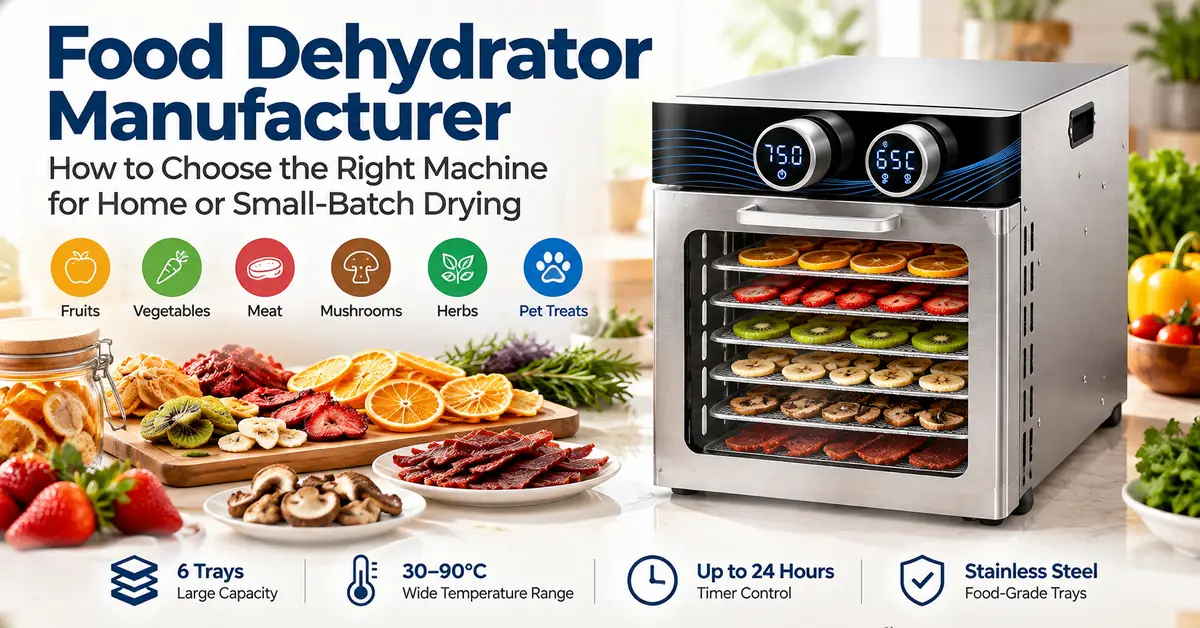
Several SZK Kitchen dehydrator models list:
-
Temperature adjustment from 30°C to 90°C
-
800W rated power
-
Timers extending up to 24 hours
-
Electronic dial or knob controls
-
Digital display functions on selected models
These specifications help retailers explain the product's functionality.
However, rated temperature range alone does not establish uniform drying performance.
Ask the supplier whether temperature consistency and airflow have been evaluated under a representative food load.
A useful sample test should examine whether trays in different positions produce reasonably consistent results under defined conditions.
3. Check Stainless Steel Materials and Food-Contact Components
Material specifications influence durability, cleaning, and product positioning.
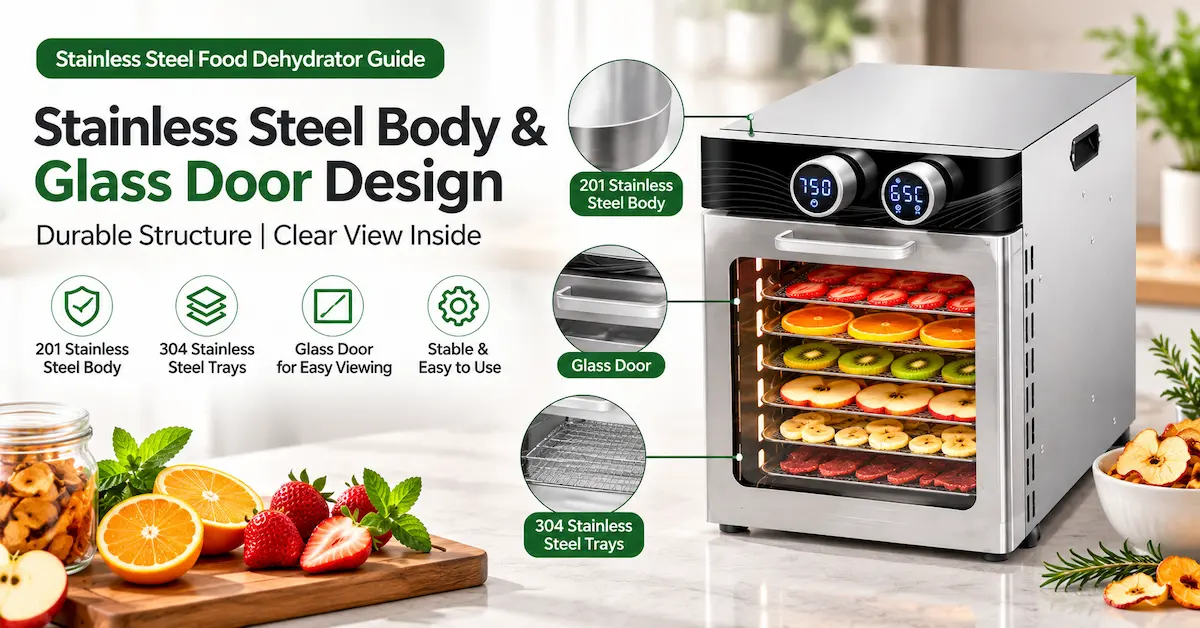
SZK Kitchen's referenced food dehydrator models list different stainless steel grades for different components.
| Component | Listed Material | Purchasing Consideration |
|---|---|---|
| Cabinet body | 201 stainless steel | Structural construction and appearance |
| Food-drying trays | 304 stainless steel | Food-contact material and cleaning |
| Front door | Glass panel with metal frame | Product visibility and cleaning |
For wholesale sourcing, buyers should confirm the exact material of each relevant component.
Do not assume that a product advertised as a stainless steel dehydrator has a body made entirely from 304 stainless steel.
Importers should also request relevant food-contact documentation for their destination market.
4. Compare Product Dimensions and Packaging Costs
Shipping costs can significantly influence wholesale profitability, particularly when importing relatively bulky electrical appliances.
A dehydrator's carton dimensions may affect storage planning, freight charges, warehouse handling, and delivery costs.
Consider the following published specifications:
| Model | Product Dimensions | Carton Dimensions | Gross Weight |
|---|---|---|---|
| 6-Tray Dial | 31.7 × 43.2 × 33.5 cm | 51.4 × 39.7 × 40.3 cm | 8.28 kg |
| 12-Tray Compact | 30 × 31 × 41 cm | 36.5 × 36.5 × 49.5 cm | 8.6 kg |
| 12-Tray Angled | 42 × 31 × 46.5 cm | 48 × 40 × 52 cm | 11 kg |
| 18-Tray Compact | 30 × 31 × 55.5 cm | 37.5 × 36 × 63.5 cm | 10.8 kg |
The 12-tray angled model also lists a wooden-crate packaging option with different dimensions and gross weight.
A higher tray count does not necessarily mean proportionally higher freight costs.
For example, the 18-tray compact model has a relatively narrow footprint, although its greater height affects packaging.
Wholesale buyers should calculate shipping costs using the final approved carton, not only the appliance's product dimensions.
5. Understand Wholesale Pricing and Total Landed Cost
A supplier's advertised unit price does not necessarily represent the total cost of a wholesale purchase.
Depending on order terms, additional expenses may include:
-
Custom packaging
-
Branding and labeling
-
Freight
-
Import duties and applicable taxes
-
Inspection and sample testing
-
Warehouse handling
-
After-sales service provision
A useful purchasing formula is:
Estimated Landed Cost per Unit = Product Cost + Customization and Packaging + Freight + Applicable Import Costs + Allocated Quality-Control Costs
Retailers can then compare their expected selling price against the fully calculated landed cost.
Before ordering, ask for an itemized quotation specifying quantities, product versions, packing details, trade terms, and included services.
6. Verify MOQ, Samples, and OEM/ODM Options
MOQ, or minimum order quantity, is an important consideration for businesses testing new product categories.
Several standard food dehydrator models on SZK Kitchen's website list a minimum order quantity of one unit.
This may allow interested buyers to discuss a sample or small initial order.
However, a one-unit product listing MOQ does not mean all customized wholesale orders have the same minimum.
For OEM/ODM orders, confirm:
-
The minimum quantity for standard products
-
Whether custom logos require a separate MOQ
-
Minimum packaging-printing quantities
-
Sample charges and shipping
-
Customization development costs
-
Final production and delivery requirements
SZK Kitchen describes OEM/ODM services through its manufacturing operation, including product customization and packaging support.
Buyers should request written confirmation of the specific options available for their chosen dehydrator.
7. Confirm Product Quality and Destination-Market Requirements
A responsible wholesale food dehydrator supplier should help buyers understand the technical characteristics and documentation associated with each product.
Important checks include electrical safety, food-contact materials, product identification, labeling, instructions, and sample performance.
For example, products shipped to North America may require different electrical specifications and documentation from products supplied to European markets.
Do not assume that every model supports all voltages or carries identical certifications.
Before approval, request applicable certificates or test reports identifying the actual model and configuration.
For distribution into professional foodservice environments, confirm whether the product is appropriate for the intended commercial use.
Wholesale Food Dehydrator Model Comparison: Which Configuration Should You Stock?
Choosing the right assortment requires balancing end-user requirements with purchasing and logistics considerations.
The following comparison focuses on four SZK Kitchen models.
| Model | Main Features | Advantages | Limitations | Recommended Buyer |
|---|---|---|---|---|
| 6-Tray Electronic Dial | 800W, 6 trays, 30–90°C | Fewer trays, relatively low cabinet height | Less total tray area | Home appliance retailers |
| 12-Tray Compact | 800W, 12 trays, 18.5L | Narrow footprint, digital display | Smaller individual trays | General kitchen appliance distributors |
| 12-Tray Angled | 800W, 12 large trays, recipe presets | Larger tray area, additional preset functions | Wider cabinet and larger packaging | Feature-focused retail brands |
| 18-Tray Compact | 800W, 18 trays, 27L | More separate loading levels | Taller cabinet, more trays to clean | Frequent-use product assortments |
Which Model Offers the Best Wholesale Value?
There is no single best model for every market.
A distributor targeting occasional home users may prefer a smaller machine with simpler positioning.
A retailer targeting families who regularly prepare dried fruit may find a 12-tray model suitable.
A private-label brand seeking a product with more drying levels may consider the 18-tray compact configuration.
The best wholesale choice depends on customer demand, available retail space, target selling price, product performance, and final landed cost.
Practical recommendation: Start with a limited range of clearly differentiated models and validate demand before expanding to additional configurations.
Common Wholesale Buying Mistakes and How to Avoid Them
Mistake 1: Choosing the Lowest Quotation Without Comparing Specifications
Two dehydrators that look similar may differ in tray dimensions, materials, controls, packaging, and electrical configurations.
A lower unit price does not automatically translate into a lower total ownership or distribution cost.
Better approach: Compare quotations using the same product specification checklist.
Mistake 2: Skipping Sample Testing
Catalog photographs and specification sheets are useful, but they cannot fully demonstrate real operating performance.
Before placing a substantial order, evaluate a physical sample.
Check:
-
Product dimensions and construction
-
Tray installation and removal
-
Temperature and timer functions
-
Drying performance under defined test conditions
-
Noise and operating usability
-
Packaging protection
-
Manuals, labels, and included accessories
Record the test conditions so the approved sample can serve as a reference for production and inspection.
Mistake 3: Assuming All Drying Applications Are Identical
Drying fruit, herbs, vegetables, and meat requires different preparation methods and safety precautions.
The National Center for Home Food Preservation explains that effective dehydration depends on heating and air circulation.
For meat products, appropriate heat treatment is particularly important. A dehydrator's maximum air temperature alone is not proof of a safe jerky-making process.
Retailers should avoid unsupported claims such as guaranteed shelf life, universal drying times, or suitability for every ingredient.
Mistake 4: Failing to Confirm Electrical Compatibility
Voltage and frequency requirements vary by country.
Certain SZK Kitchen product pages list specific voltage options, while others provide only partial electrical details.
Do not assume that all models are interchangeable across different markets.
Confirm the exact voltage, frequency, plug configuration, and applicable documentation before importing.
Mistake 5: Overlooking Delivery Terms and After-Sales Support
Production schedules vary by inventory, customization requirements, quantities, and packaging.
A standard in-stock order can have a different schedule from a private-label manufacturing project.
Before committing to an order, clarify:
-
Production and dispatch dates
-
Shipping method and responsibilities
-
Packaging requirements
-
Inspection arrangements
-
Spare parts availability
-
Warranty or return conditions
-
Procedures for damaged or defective goods
These details should be included in the confirmed purchase agreement.
Recommended SZK Kitchen Food Dehydrators for Wholesale Buyers
SZK Kitchen offers food dehydrators with different configurations through its manufacturing-related business, Tiansui Electric.
For buyers building a product assortment, the following three models provide a useful starting point.
1. 6-Tray Food Dehydrator with Electronic Dial Control
The 6-Tray Food Dehydrator with Electronic Dial Control provides a smaller tray configuration suitable for buyers targeting occasional food-drying customers.
Published specifications:
-
Six stainless steel trays
-
29 × 29 cm tray dimensions
-
800W rated power
-
Adjustable 30–90°C temperature
-
Adjustable timer up to 24 hours
-
201 stainless steel body
-
304 stainless steel trays
-
Glass-door construction
Wholesale positioning: A potential entry-level configuration for kitchen appliance retailers that want to offer a six-tray stainless steel model.
View 6-Tray Dehydrator Product Details
2. 12-Tray Compact Food Dehydrator with Digital Display and Knob Control
The 12-Tray Compact Food Dehydrator offers more tray levels while maintaining a relatively narrow cabinet design.
Published specifications:
-
Twelve stainless steel trays
-
28.5 × 20 cm tray dimensions
-
18.5L listed internal capacity
-
800W rated power
-
Adjustable 30–90°C temperature
-
Timer up to 24 hours
-
Digital display and knob control
-
304 stainless steel trays
-
Product dimensions: 30 × 31 × 41 cm
Wholesale positioning: A candidate for mid-range kitchen appliance ranges serving customers who dry food regularly.
Explore the 12-Tray Compact Food Dehydrator
3. 18-Tray Compact Food Dehydrator with Digital Display and Knob Control
The 18-Tray Compact Food Dehydrator provides a taller cabinet with additional drying levels.
Published specifications:
-
Eighteen stainless steel trays
-
28.5 × 20 cm tray dimensions
-
27L listed internal capacity
-
800W rated power
-
Adjustable 30–90°C temperature
-
Adjustable 0.5–24 hour timer
-
304 stainless steel trays
-
Product dimensions: 30 × 31 × 55.5 cm
Wholesale positioning: Suitable for distributors seeking a higher-tray-count option for customers who frequently prepare multiple food batches.
View the 18-Tray Compact Food Dehydrator
Additional Option: 12-Tray Angled Food Dehydrator
The 12-Tray Angled Food Dehydrator with Recipe Presets is worth comparing with the 18-tray compact machine.
Its larger 29 × 29 cm trays provide approximately 1.009 m² of nominal total tray area, offering a different balance of tray count, dimensions, and features.
For distributors, this model may suit a product range emphasizing larger individual trays and preset operating functions.
Why Consider SZK Kitchen for Food Dehydrator Wholesale Sourcing?
SZK Kitchen is associated with Hong Kong United Profit Group Limited and its manufacturing subsidiary, Foshan Tiansui Electrical Appliance Co., Ltd.
According to the company's About Us page, its manufacturing operations are located in Shunde, Foshan, China.
The company describes capabilities covering appliance development, manufacturing, quality inspection, and OEM/ODM support.
For international wholesale buyers, several aspects are worth discussing.
Product Variety
The SZK Kitchen food dehydrator collection includes different tray counts, cabinet formats, and control configurations.
This gives importers an opportunity to compare product types according to their retail positioning.
OEM/ODM Cooperation
The company advertises customizable kitchen appliance solutions.
Potential projects may include brand identification, appearance changes, packaging, and selected product configurations.
The scope of each project should be confirmed before sampling or mass production.
Sample Orders
Several food dehydrator product listings specify a one-unit minimum order quantity.
This provides a starting point for sample discussions, although wholesale and private-label requirements may differ.
Manufacturing and Quality Discussions
The company describes internal manufacturing and quality inspection processes.
Buyers can request documentation for material specifications, quality checks, product testing, and applicable market requirements.
International Shipping Coordination
SZK Kitchen's published shipping policy describes coordination of international shipping options, with charges depending on destination, dimensions, packaging, order quantity, and delivery method.
Final shipping responsibilities and delivery schedules should be confirmed in writing.
How to Request a Wholesale Food Dehydrator Quotation
A detailed inquiry helps a supplier recommend suitable equipment and prepare a more useful quotation.
Before contacting the supplier, prepare the following information:
| Information | Example |
|---|---|
| Target market | United States, Germany, Australia |
| Buyer type | Importer, distributor, private-label brand |
| Preferred model | 6-tray, 12-tray, or 18-tray |
| Intended application | Household fruit and vegetable drying |
| Expected order quantity | Initial sample plus proposed bulk order |
| Electrical requirements | Required voltage, frequency, and plug |
| Branding | Standard product or private label |
| Packaging | Standard carton or custom printed box |
| Required documentation | Destination-specific compliance and testing records |
| Delivery requirements | Destination, preferred shipping terms, desired schedule |
Providing these details makes it easier to compare quotes and avoid misunderstanding during order confirmation.
Ready to source food dehydrators for your business?
Explore SZK Kitchen's Food Dehydrator Collection and contact the supplier to discuss model selection, sample availability, OEM/ODM requirements, and wholesale quotations.
Frequently Asked Questions About Wholesale Food Dehydrator Suppliers
1. What is the minimum order quantity for wholesale food dehydrators?
Minimum order quantities depend on the model and the type of order.
Several SZK Kitchen standard dehydrator listings specify an MOQ of one unit, which may be useful for sample purchases.
Bulk wholesale and customized private-label orders should be quoted separately because branding, packaging, and production requirements can affect minimum quantities.
2. Can a wholesale food dehydrator supplier provide custom branding?
Some manufacturers offer OEM/ODM services for private-label brands.
SZK Kitchen describes customization support, including product and packaging requirements.
Buyers should confirm the available logo, packaging, color, and configuration options for the selected model, together with any associated costs or minimum order quantities.
3. What is the difference between a 12-tray and an 18-tray food dehydrator?
The primary difference is the number of separate drying levels, but tray dimensions also matter.
SZK Kitchen's 12-tray angled model uses larger individual trays than its 18-tray compact model.
As a result, their calculated total nominal tray areas are similar.
Compare tray area, cabinet dimensions, spacing, cleaning requirements, and intended food loads before choosing.
4. How can wholesale buyers verify food dehydrator quality?
Request a sample and assess its construction, food-contact materials, control functions, electrical configuration, packaging, and drying performance.
The supplier should also be able to discuss inspection requirements and provide applicable product documentation.
Use written acceptance criteria for larger orders so the delivered products can be compared with the approved sample.
5. How long does wholesale food dehydrator delivery take?
Delivery time depends on stock availability, customization, order quantity, and destination.
SZK Kitchen publishes different timelines for stock products and customized projects. These should be treated as general guidance rather than unconditional commitments.
Ask for the production completion date, dispatch schedule, shipping method, and estimated delivery arrangement for your actual order.
6. How do I choose between a manufacturer and a trading supplier?
Both manufacturers and trading companies can provide legitimate supply services.
A manufacturer may offer more direct access to product development, technical clarification, and customization discussions, while a trading supplier may offer sourcing across multiple factories.
Compare the actual factory identity, product quality, pricing transparency, inspection arrangements, after-sales responsibility, and contractual terms before making a decision.
Conclusion
Choosing a wholesale food dehydrator supplier requires more than selecting an attractive appliance or accepting the lowest quotation.
For importers, distributors, and private-label brands, successful sourcing depends on matching the right product configuration to the intended market.
A 6-tray model may suit an entry-level retail assortment, while 12-tray and 18-tray models provide different options for frequent users. Tray dimensions, temperature control, material specifications, packaging costs, and electrical requirements should all influence the selection.
Before placing a bulk order, verify samples, customization options, quality documentation, shipping arrangements, and total landed costs.
SZK Kitchen offers a range of stainless steel food dehydrators and describes OEM/ODM support through its manufacturing operations in Foshan, China.
Explore the SZK Kitchen Food Dehydrator Collection or contact SZK Kitchen to discuss product specifications, samples, private-label requirements, and your next wholesale order.